Blog: July 2007

Talking at SFU

July 28, 2007

Friday, I spent a nice morning talking to a class at Simon Fraser University.  I was asked to join Monique Trottier, who was leading a class called “Marketing Magazines Online.”

Despite my own initial confusion about which classroom it was in, I had luckily planned for at least 60 minutes of being lost, so I still managed to arrive to the class 35 minutes early and so was able to see Monique teach for a while.  I was quite impressed—she has a wonderful ability to remember to explain things that she already knows but her audience might not. I know that this is one of my occasional teaching errors; I use terms and concepts that I’ve understood for years but that are still quite naturally new to my students.

In any case, the group was a great one; good questions and interesting insights.  We talked about the rise of “Share” icons (the ones Matt just talked about) and about Google News’s quirks and how they are different than the main Google index.  We talked about design trends for modern magazines online, and when a blog might be a better choice than a series of articles, or vice versa.

We also ended with a quick tour of the Internet Archive’s Wayback Machine and had a little fun looking at how publications looked in the mid 1990s.  That site offers a great way to see trends in publishing.

Posted by Travis Smith at 1:07 PM | Comments (1)


Truthdig Needs Those Stinking Badges

July 20, 2007

The infestation started on blogs, and spread across the internet like diamonds on Elton John’s costumes: tiny icons first spotting the collar line of blog posts, soon shining from the tails of news sites. Now they grace the prestigious brow of Truthdig.com, in elegant dropdown form.

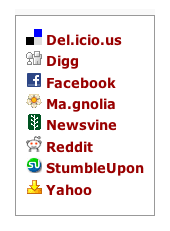
icons Image

Aggregator sites, those giants of The Web We Call 2.0, have developed these badges as tiny outposts of imperialistic intent. On a basic level each icon is a trigger for the functions of its parent site, and the plethora exists so that you can pick your favorite flavor.

On many sites and blogs the icons are unlabeled, and choosing the right one is problematic, as each site does different things, calls the same things different names, and struggles for dominance in the web jungle. On Truthdig we have named them Save and Share, or Share Icons.

Hop Studios, working with Truthdig, narrowed the list to eight of the most user friendly and popular Service sites. We hope that these new tools help even more people find, use and enjoy Truthdig!

Posted by Matt Gardner at 1:10 PM | Comments (0)


An FTP Hacking Attack

July 18, 2007

Another client of ours suffered a minor hacking attack, and I thought I’d take a moment to let you know how we think it was done, so you might be able to avoid it yourself.

Susie was editing a client’s site recently (for the purposes of this attack, it doesn’t matter which one) and noticed that in the content management system, ExpressionEngine, there had been a number of nearly invisible links added to many of the templates, including the footer.

What was added, was a one pixel image, that linked from the client’s site to a site that offered recipes—chicken recipes, to be exact.  That site had zillions of Google ads, and not much in the way of content.  The site was owned by someone in Romania with a Gmail address.  It was essentially a site whose sole purpose was to gather searchers looking for recipes, which are a commonly searched item online, and turn those searches into cash.

In addition to the template changes, there was also a small graphic added to the client’s images directory.  So whoever did the hack had FTP or file-level access, as well as access to the database.

All in all, it was an almost undetectable hack, with very little consequence to the site in question—all our client’s site was doing was giving this chicken recipe site a boost in search engines, by pointing links to it from every page.  We figure that the change had been in place for at least several weeks, perhaps longer.

We immediately changed every password on that server—EE passwords, FTP passwords, and email passwords—and removed all the links, which was a bit of a whack-a-mole hunt.

We’re almost certain that the attacker first got the FTP password, and from there identified the EE database password by looking through the files. He (hackers are usually ‘he’s) then inserted the code into EE directly by accessing the database.  There’s clear evidence that the EE interface was not used to insert the recipe links.

So, how did the attacker get the FTP password? Well, that’s unclear.  But if you use regular FTP, there are many points between your computer and your server that the password, which is sent unencrypted, can be captured—from intervening routers, from an unsecured wifi network, etc. So starting immediately, we’re going to start using SFTP for every client, for every connection.  (We had been using SFTP for some sites, but not as a universal policy.)

If you still use regular old FTP, you’re taking a risk that simply doesn’t need to be taken—like leaving your keys in your car.

And if you’re using EE—it looks like there’s at least one sophisticated hacker out there who can figure out how to subvert your EE installation simply with database access.  EE is as secure and safe as any system I’ve used, but if it’s on an unsecured server, it’s just as vulnerable as the worst software out there.

Posted by Travis Smith at 3:10 PM | Comments (2)


Now Showing on The Lab with Leo Laporte

July 13, 2007

In the past month, I’ve done three tapings for appearances on a TV show called The Lab with Leo Laporte, a G4 Tech TV show about all things technological. My segment is called “Web Workshop,” and in it I do a lightening fast design and functionality review of user-submitted Web sites. Leo Laporte jokes that I’m going to be brutal, but really I’m trying to be pretty concrete with my advice and suggestions. It’s pretty fun doing the segments, and really interesting to see how a show like this is put together.

No promises that this schedule will remain accurate, but the shows with my segments are supposed to air July 31, August 17, and September 11. Let me know if you see them!

Posted by Susannah Gardner at 4:12 PM | Comments (1)


World Hum Acquired by Travel Channel

July 8, 2007

Congratulations to Hop Studios’ client World Hum, who recently (OK, fine, in late May) announced some great business news.  They have been acquired by the Travel Channel!

We’ve talked about World Hum’s development in the past, such as their relaunch in June 2005. But we’re especially happy about this latest milestone on their journey from being a labor of love, to being a more and more widely read travel writing site, to what they’ve become now.

The process of getting bought was interesting from our point of view.  The investors, anonymous to us at the time, asked Hop Studios all sorts of technical questions about the site’s underpinnings and organization.  We’re glad for World Hum’s sake that they’d chosen to build with a robust and flexible publishing system, one that not only made it possible for them to publish quickly and efficiently, but one that evidently added value when it came to for their site to be appraised.

As I’m sure owners Jim and Michael would tell you, it’s not about the destination, it’s about the journey—and World Hum’s writers have not only had an interesting journey, they also have a lot more road ahead. We look forward to traveling with them as we continue to explore what it takes to be a premier media site.

Posted by Travis Smith at 10:54 PM | Comments (3)


The American Studies Association Web Site: Redesigned

July 3, 2007

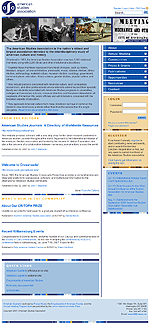
The old siteHop Studios is really excited about the launch of our latest project: a redesign of the American Studies Association Web site. This was a huge overhaul, migrating an enormous number of flat files into a database, building in template efficiencies across the site, and even designing a new logo and look. The old site was put together in the very early days of the Web—in fact, we’d go so far as to say the ASA was on the cutting edge when they first put up a Web site in the ‘90s. But like so many Web sites, the site grew. And grew. And grew.

It grew way beyond its original design, and beyond its information architecture, and as time passed it started to look a lot like a list of links. At the same time, it became harder for the folks maintaining the site to know what was already there—and so duplication of content began to occur. So when the ASA decided they needed to redesign, our first task was to corral all this content. We did an extensive survey, made maps and charts and spreadsheets, and working with John Stephens, president of the ASA, decided what to keep and how to organize all that content. In the process, we realized we could make maintaining the site a lot easier in big and little ways.

For example, a big feature of the site are the dissertation abstracts. Since 1986, the ASA has kept an archive of dissertations in American Studies, and it has been an invaluable research tool for those in the field, and a big pain to maintain. Each year, staff has had to painstakingly compile alphabetical and date-based lists of abstracts by hand. And, while you could easily look up a dissertation by the author’s last name, finding the most recent abstracts or those from a particular school took a lot of clicking and reading. Now, thanks to the database behind the site, the ASA can slice and dice the dissertations several ways—alphabetically by author or title, by school, and by date—and with no extra work.

The old siteThe most exciting parts of the site, however, are the member directory and the community pages designed to be used by the projects, chapters, caucuses and committees of the ASA. Geographically, the ASA members get together only once a year as a group for their annual meeting. But the work of American Studies is year-round, and the need to collaborate is ongoing. Now, via the Web site, members of the ASA can contribute to blogs within community groups, build out an extensive profile, and find other members to work with by looking at expertise and research areas. Over time, the hope is that the site will make it possible for members to make new and exciting connections with each other. We can’t wait to see what they make of these new tools ourselves.

Posted by Susannah Gardner at 11:29 AM | Comments (0)


From the Blog

  • Click to fill out the Hop Studios Quote Request Form


Recent Blog Posts

RSS Feed


Archives