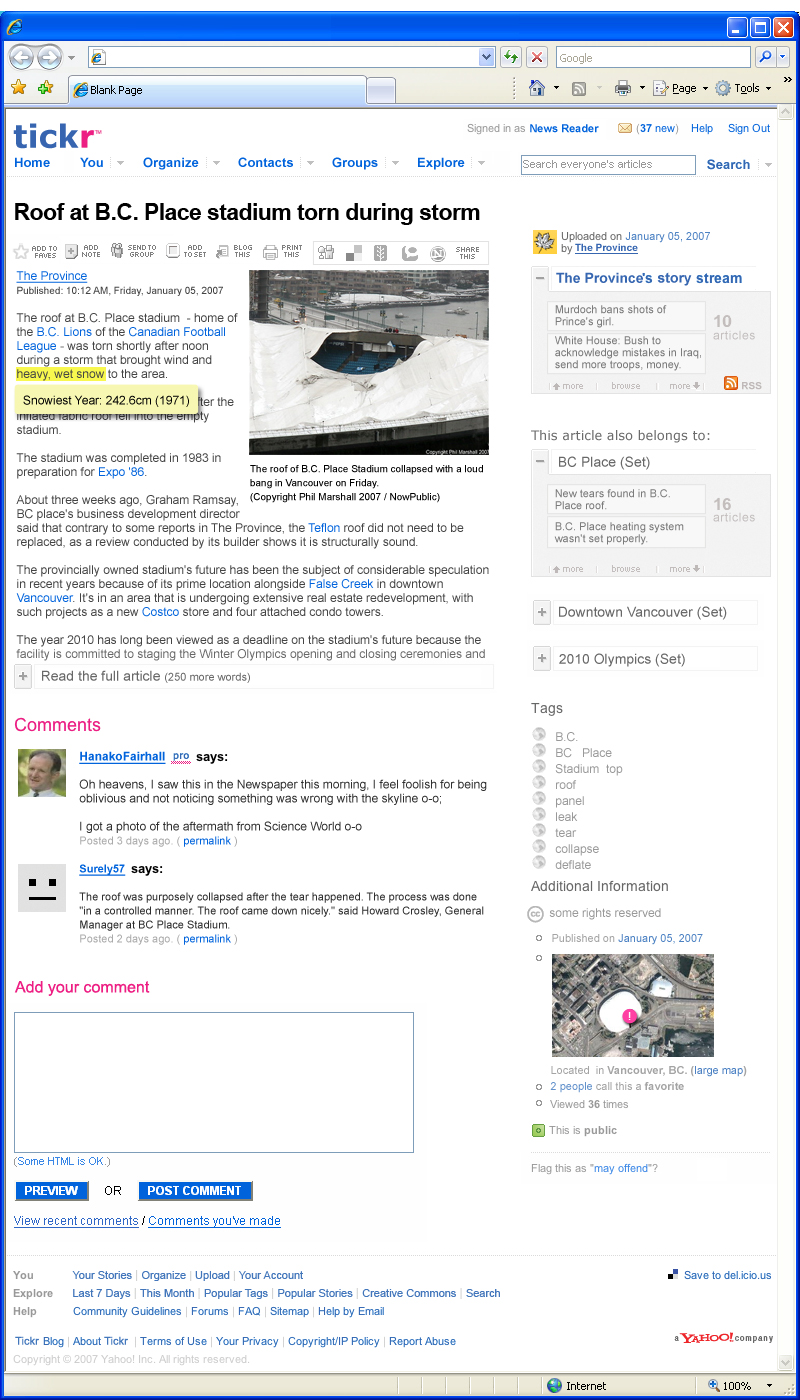
Flickring the News
|
A THOUGHT EXPERIMENTFlickring the News is a thought experiment based on a design riddle we posed to ourselves not too long ago. "What if," we asked ourselves, "news sites were built for sharing instead of for telling?" This is what evolved from that question. What we hope we will demonstrate here is how any traditional online media site could effectively jettison the historic print layout model (aka the bath water). In its place, we suggest using the design model of any successful social media site to give power to the reader and focus to the individual story instead of the home page. We think this amplifies the best features of news exchange and online community (aka the baby). WAIT... SOCIAL MEDIA?There's no universal definition of the term "social media" (even wikipedia could use some help), but here's how we've defined a "social media site":
After we developed it, we noticed this definition may differ from the definition of a "traditional media site" by only one word: replace "share" with "receive." Traditional media outlets do target a group of like-minded individuals (whether that commonality be geography, hobby, job, politics or some other common denominator). They do create and publish stories and experiences. But they have, up to this point, avoided or outright discouraged sharing among the site's users. This has been the case for traditional media sites, generally speaking, since the beginning of the Web. Even the most lauded media sites of the past decade have done little to highlight and encourage community participation. For example, as recently as March 2007, The Washington Post has debated whether to continue to allow comments on articles. GROWING POPULARITYMeanwhile, in the past few years, a group of social media sites have grown in popularity and influence under a sort of general label called Web 2.0 -- you can see their proliferation in the little rows of icons, for example on this page. YouTube, MySpace, Flickr, Blogger, Facebook, Wordpress, Digg, Metafilter, Wikipedia and others share a common theme: they are all sites where users' contributions to each other's work add tremendous value and knowledge to the information on the site. (Well, maybe not in the case of YouTube's comments, but it's true for the rest of them.) Traditional media outlets Click to see that design lesson >>>
First posted April 4, 2007 |
HOP STUDIOS INTERNET CONSULTANTS
|
© Copyright 1995 - 2007 Hop Studios
|